
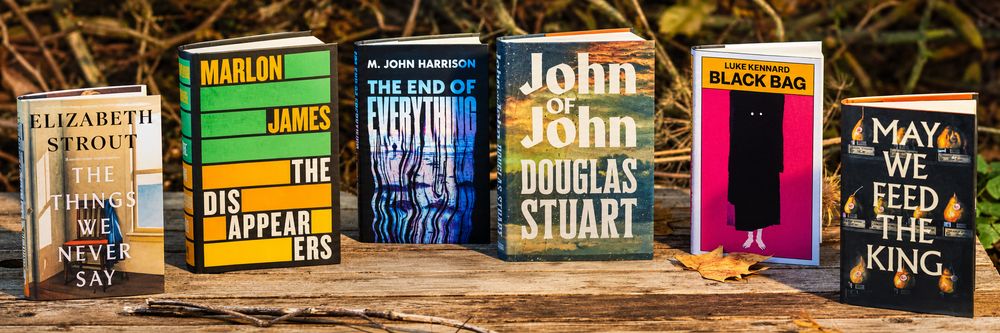
With the 2026 Booker Prize winner set to be announced on 9 November, the AWF team has been reading its way through this year's shortlist. From post-apocalyptic science fiction to sweeping literary epics, we've stepped outside our reading comfort zones, discovered some extraordinary writing and formed a few strong opinions along the way.
Here's what we thought of the books we've read.
Grace Sinclair – Programme Manager
The Disappearers. Marlon James
A recent write-up in The New York Times appointed Marlon James' latest, The Disappearers, "the Novel of the Decade, if not the Century". For most books and authors, a declaration so effusive may be daunting but it feels fitting that the reviews of his novel are just as momentous as the craft and scope of this 600+ page epic. I'm not sure I can add much new to the discourse around this book, every exceptional review it has received is deserved.
The novel’s defining event, set in the backdrop of 1980s Kingston, Jamaica, is a gruesome homophobic mob attack on eight gay men who are in rehearsals for a play. The book is told in 5 parts (or acts) and the narration switches around, as the men left behind seek to process the central violence that occurred. James explores the many ways in which people can disappear, willingly or by force, however, this violent, heady and affecting story won't be disappearing from my mind anytime soon.
Lyndsey Fineran – Artistic Director
Black Bag. Luke Kennard
If you would have told me that my favourite sex scene that I’d read in 2026 would involve a man dressed in a black body bag, I would have (deservedly) raised an eyebrow at you (and perhaps, even more deservedly, at myself).
But here we are, and I loved my time in Luke Kennard’s offbeat world, where an out-of-work actor takes on the role of ‘black bag’ in a psychology experiment—and the line between where he ends and the bag begins starts to blur.
It’s wildly original and inventive, with deadpan wit and sharp observations that had me laughing page after page. The premise might seem unhinged (and it is), but beneath it lies perceptive thinking about male interiority, the value of connection and the impulse to keep making art as the world seems to career towards its end.
Catriona Ferguson – Managing Director
The Things We Never Say. Elizabeth Strout
Elizabeth Strout celebrates the tongue-tied, the inarticulate and those who are throttled by their own feelings. In The Things We Never Say, we meet Artie Dam, a much-loved history teacher who is considerably better at supporting his students than understanding his own unhappiness.
On paper, Artie’s life looks comfortable - a long marriage, a meaningful job, weekends sailing off the Massachusetts coast. On the inside though, things aren’t so shipshape, and when a revelation upends everything he thought he knew about his life, he is forced to take stock.
Strout gets inside her characters heads with forensic precisionand masterfully captures the awkward business of being close to other people; the small kindnesses, private disappointments and conversations we rehearse but never actually have. Her writing is spare, perceptive and quietly devastating, with moments of recognition that made me wince. There’s also an extraordinary tenderness towards people who keep getting things wrong and keep trying anyway.
This year’s Booker shortlist is a banger, but The Things We Never Say would be a thoroughly worthy winner.
Jill Rawnsley – Festival and awards co-ordinator
May we Feed the King Rebecca Perry
I started May We Feed the King knowing nothing about the author but could tell pretty quickly this was the work of a poet, an award-winning poet as it turns out. You can read MWFTK quickly thanks to her careful use of language, but you will want to go back to it again to luxuriate in the detail.
A curator of domestic scenes for historic buildings is commissioned to prepare exhibits in a palace for some nebulous 750th anniversary. As the curator pores over castle ledgers, their research leads us into the world of a rebel king – in that he would rather not be one. His refusal to kill traitors, exploit neighbouring countries’ weaknesses and an inability to sire an heir leads to a mutinous court and rampant rumours about his sexual proclivities. The curator creates, in meticulous fashion, the scene left behind as the king’s final hours of power descend. May We Feed the King is a poetic masterpiece. Highly recommended.
Lyndsey Fineran – Artistic Director
John of John. Douglas Stuart
Oh, John of John. What a novel! I had the pleasure of listening to this on audiobook (brilliantly read by Lorne MacFadyen) and months later I can still vividly recall its rugged, windswept Hebrides setting; the tense, complex dynamics between a returning art school graduate son and his Presbyterian father, and the layers of repression, misunderstandings and achingly sad missed connections that reveal themselves over the novel’s course.
It’s a tough read / listen (and I still have quite the pang in my chest when I think back to it), but it has incredible humour too, and such an acute ear for dialogue and the Scots’ brilliant turns of phrase. A hugely accomplished novel that I’d highly recommend to many types of reader.
Suzanne McNamara – Marketing and Audience Development Manager
The End of Everything M. John Harrison
It’s good to step out of your book genre comfort zone, right? This is what The End of Everything signalled to me, so why not give literary sci-fi in a post-apocalyptic world a crack? M. John Harrison writes with a dream like structure, where nothing much happens and when something does, ever so slowly, it can be a little hard to grasp what it is that is happening. Quite suddenly and out of character, there will be violence.
It is in parts as bleak as it is beautifully written. In our real world, as we teeter on the edge of the AI abyss, the ighetti–the super-intelligent enigmatic aliens in the story who have captured London–made me shudder. You never really meet one or perhaps you do? The artefact could be connected but it might not be? Perhaps the ighetti were created by iapple?
There is enough ambiguity to leave it open to your imagination.